Showing posts with label Defamation. Show all posts

Saturday, June 4, 2022

"Personal Injury" (Defamation) Coverage under a PULP -- Depp v. Heard Defense Costs


From my LinkedIn post today (Sat., June 4, 2022):

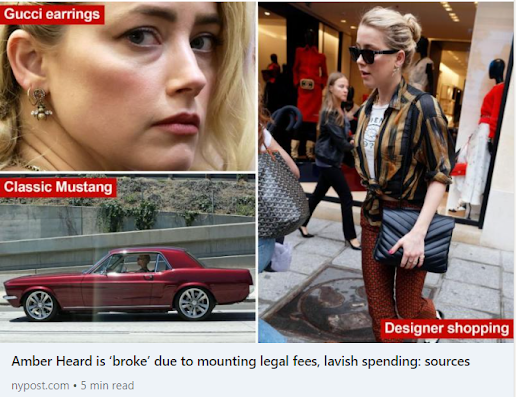
I rarely learn anything useful from the New York Post, but this article reports that Amber Heard "had to switch legal representation and is relying on her homeowner’s #insurance policy to cover the cost of her attorneys in the case. The bill for Heard’s attorney has mostly been footed by The Travelers Companies, Inc under terms of the actress’s insurance policy, sources said." "Mostly" likely because Travelers would not be responsible for paying attorneys' fees and costs associated with the prosecution of Heard's $100 million counterclaim against Depp.

Most homeowners policies don't provide coverage for "personal injury", defined to include "injury arising out of one or more of the following offenses, but only if the offense was committed during the policy period: *** 4. Oral or written publication of material that slanders or libels a person or organization or disparages a person's or organization's goods, products or services[.]" Personal umbrella policies typically provide "personal injury" coverage. I'm guessing that the Travelers policy that provided defense costs is a PULP (personal umbrella liability policy) sitting above Heard's homeowners policy.

The article is probably correct, however, in pointing out that Heard's policy with Travelers will likely NOT provide indemnification coverage for Johnny Depp's $10 million compensatory damages verdict against Heard. PULPs typically exclude personal injury coverage for:
"Personal injury":
a.  Caused by or at the direction of an "insured" with the knowledge that the act would violate the rights of another and would inflict "personal injury";
b.  Arising out of oral or written publication of material, if done by or at the direction of the "insured" with knowledge of its falsity;
c.  Arising out of oral or written publication of material whose first publication took place before the beginning of the policy period;
d.   Arising out of a criminal act committed by or at the direction of an "insureds"; or
e.  Sustained by any person as a result of an offense directly or indirectly related to the employment of this person by the "insured"[.]
The jury's positive finding on each of the prima facie elements of defamation on the three statements in Heard's op ed piece likely triggers at least one of these exclusionary provisions--"b."--and possibly two of them--"a." and "b."

I'm no bankruptcy lawyer but I do know that judgments based on intentional torts, like libel with malice aforethought, are NOT dischargeable in bankruptcy.

#personalinjury #defamation #insurancecoverageinthenews


Saturday, January 25, 2014

Defamation Claim Against Property Insurer Dismissed

COMMERCIAL PROPERTY – ARSON – DEFAMATION – COMMON INTEREST QUALIFIED PRIVILEGE – GENERAL BUSINESS LAW § 349
Farm Fresh Gourmet Salads, LLC v. Sentinel Ins. Co.
(Sup.Ct., NY Co., decided 1/10/2014)

It has been my observation that the assertion of defamation causes of action against property insurers has become more common over the past few years, especially in claims investigated or denied for possible fraudulent or intentional conduct.  I guess that's why I developed a training presentation on this topic nearly four years ago.  I've also blogged about a number of New York cases before, which you can review here.

In this case, Sentinel investigated its insured's fire loss and denied coverage based, in part, on its conclusion that the insured caused or procured the fire.  The disclaimer letter sent to the insured and copied to the insured's attorney, public adjuster and insurance agent stated: "Sentinel's investigation has determined that the fire was the result of an intentional act caused or procured by the insured, or someone acting on its behalf."

A summons and complaint followed, with the complaint unsurprising alleging a breach of contract cause of action.  Presumably in an effort to recover plaintiffs' attorneys' fees in the event they prevailed, also somewhat unsurprisingly the complaint alleged a violation of New York General Business Law § 349, New York's deceptive business acts and practices act.

But what caught my eye when I read this decision was its mention of the defamation causes of action against the insurer AND its adjuster who had signed the disclaimer letter.  Is it possible to deny coverage based on the insurer's conclusion that its insured intentionally caused or procured the loss, or breached the policy's fraud/misrepresentation condition, without incurring defamation liability?  As this case illustrates, the answer is yes, of course it is.

Defendants made a motion for partial summary judgment to dismiss the complaint's two defamation causes of action.  In GRANTING that motion, New York County Supreme Court Justice Eileen Rakower agreed that the common interest qualified privilege applied to preclude defamation liability:
Defamation arises from "the making of false statement which tends to expose the plaintiff to public contempt, ridicule, aversion or disgrace, or induce an evil opinion of him in the minds of right-thinking persons, and to deprive then of their friendly intercourse in society." Foster v. Churchill, 87 N.Y.2d 744 (1996)(citations omitted).
The elements of defamation "are a false statement, published without privilege or authorization to a third party, constituting fault as judged by, at a minimum, a negligence standard, and, it must either cause special harm or constitute defamation per se." Dillon v. City of New York, 261 A.D.2d 34, 38 [1st Dept 1999]. "Truth provides a complete defense to defamation claim." (Id.).
"Slander per se" "consist of statements (I) charging plaintiff with a serious crime; (ii) that tend to injure another in his or her trade, business or profession; (iii) that plaintiff has a loathsome disease; or (iv) imputing unchastity to a woman." Liberman v. Gelstein, 80 N.Y.2d 429, 435 (1992).
"Even though a statement is defamatory, there exists a qualified privilege where the communication is made to persons who have some common interest in the subject matter." (Id. at 751). "A privileged communication is one which, but for the occasion on which it is uttered, would be defamatory and actionable." (Id.). "The defense of qualified privilege will be defeated by demonstrating a defendant spoke with malice. Moreover, the conditional or qualified privilege is inapplicable where the motivation for making such statements was spite or ill will (common law malice) or where the statements [were] made with [a] high degree of awareness of their probable falsity (constitutional malice)." (Id.) (citations omitted).
Here, Defendants have established prima facie evidence of entitlement to summary judgment on the defamation/libel claims by establishing that the alleged defamatory statement was made to persons who share a common interest in the subject matter and therefore was subject to qualified privilege. The only persons that the allegedly defamatory statement was published to were Plaintiffs' lawyer, and Plaintiffs' agents handling their insurance affairs (Plaintiffs' public adjuster and insurance agent). In additionally, Plaintiffs have presented no evidence of malice to defeat this privilege.
It is important to understand that the court did not conclude that the statement contained in Sentinel's disclaimer letter was defamatory.  It concluded that even if it were, the common interest qualified privilege, undefeated by any showing of malice, applied to preclude defamation liability.

Defendants also moved for summary judgment to dismiss plaintiffs' GBL § 349 cause of action, arguing that plaintiffs had not sufficiently alleged the type of consumer-oriented deceptive practices that this statute was intended to eradicate.  Because plaintiffs did not oppose that aspect of defendants' motion, the court granted summary judgment on and dismissed that cause of action, as well.

Tuesday, February 9, 2010

Defamation Claim Against No-Fault Insurer Dismissed -- Conclusory Allegations of Malice Found Insufficient

NO-FAULT – DEFAMATION – QUALIFIED PRIVILEGE – MALICE – INSURANCE FRAUD
Hame v. Lawson
(2nd Dept., decided 2/2/2010)

Can an insurer be sued for defamation in relation to statements it makes about the insured or claimant while it is investigating whether or after it has concluded that the claim is fraudulent?  Of course it can.  Whether such a claim or cause of action will survive a dispositive motion, however, is another thing. 

In Horbul v. Mercury Ins. Group, 64 AD3d 682 (2d Dept. 2009), the Appellate Division, Second Department, dismissed plaintiff's complaint because it did not set forth the the particular words complained of, as required by CPLR Rule 3016.  Horbul had generally alleged in his complaint that Mercury Insurance committed slander per se when it reported to the police that the plaintiff had filed a fraudulent claim with it for no-fault medical benefits for his son.

Months earlier, in LeBaron v Erie Ins. Co., 59 AD3d 939 (4th Dept. 2009), the Fourth Department affirmed the dismissal of the plaintiff's slander claim against Erie Insurance Company's special investigator, which was based on discussions the special investigator allegedly had with police.  The lower court had concluded that the special investigator's qualified privilege was not overcome by the vague and conclusory allegations set forth in plaintiff's amended complaint that the statements to the police were made with ill will or with a high degree of awareness of their probable falsity.  See, also, East Point Collision Works, Inc. v. Liberty Mut. Ins. Co., 271 AD2d 471 (2d Dept. 2000)(statements Liberty Mutual's special investigator allegedly made to the insured suggesting the possibility that plaintiff collision shop had enhanced the collision damage to the insured vehicle were found to be qualifiedly privileged because they related to something -- the extent of the damage actually caused by the accident -- in which both Liberty's investigator and the insured had a common interest; there was nothing in the record to support a finding that the special investigator acted with malice in making the alleged statements). 

This decision marks the second time in less than eight months that a defamation claim against a no-fault insurer has reached the Second Department.  In AFFIRMING Kings Supreme's granting of Response Insurance Company's CPLR Rule 3211(a)(7) motion to dismiss plaintiff's complaint for failure to state a cause of action, the Second Department held that the plaintiff was required to allege that Response's statements were made solely with malice, but failed to allege any facts from which malice could be inferred and her conclusory allegations of malice were insufficient to overcome the qualified privilege that otherwise attached to the statements Response made in its no-fault denial of claim forms.

The plaintiff in this case allegedly was struck by an automobile driven by Igal Shaul.  Plaintiff filed a claim for no-fault benefits with Shaul's insurer, Response.  After conducting an investigation, including examinations under oath of the plaintiff and Shaul, Response denied plaintiff's no-fault claim, concluding that she had made "material misrepresentations and false statements" and that the incident was a "deliberate[ly] staged event." The denial of claim form was sent to three medical providers who had treated the plaintiff. After a referee determined that Shaul had been involved in the accident, the plaintiff brought this action alleging that she had been defamed when Response sent the denial to her medical providers.

In granting Response's CPLR Rule 3211(a)(7) motion to dismiss, the Second Department found that Response's statements made in the no-fault denial of claim forms were subject to a qualified privilege as both Response and the medical providers treating the plaintiff had an interest in that communication.  The appellate court also held that plaintiff had failed to allege any facts from which malice could be inferred and her complaint's conclusory allegations of malice were insufficient to overcome the privilege:
Contrary to the plaintiff's contention, the Supreme Court properly granted the defendants' motion pursuant to CPLR 3211(a)(7) to dismiss the complaint for failure to state a cause of action. The statements made in the denial of claim form were subject to a qualified privilege as both RIC and the medical providers treating the plaintiff had an interest in that communication (see Golden v Stiso, 279 AD2d 607, 608). In order to overcome the privilege, the plaintiff was required to allege that RIC's statements were made solely with malice, either under the constitutional or common-law standard (see Liberman v Geldstein, 80 NY2d 429, 438; Rohrlich v Consolidated Bus Tr., Inc., 15 AD3d 561, 562). "The plaintiff failed to allege any facts from which malice could be inferred and [her] conclusory allegations of malice were insufficient to overcome the privilege" (Red Cap Valet v Hotel Nikko [USA], 273 AD2d 289, 290; see Rohrlich v Consolidated Bus Tr., Inc., 15 AD3d at 562; Serratore v American Port Servs., 293 AD2d 464; Freidman v Ergin, 110 AD2d 620, affd 66 NY2d 645; see also Breytman v Olinville Realty, LLC, 54 AD3d 703, 704; Baker v City of New York, 44 AD3d 977, 981).
In the seminal case of Liberman v. Gelstein,  the New York Court of Appeals noted:
Under the [New York] Times [Co. v Sullivan (376 US 254)] malice standard, the plaintiff must demonstrate that the “statements [were] made with [a] high degree of awareness of their probable falsity” (Garrison v Louisiana, 379 US 64, 74). In other words, there “must be sufficient evidence to permit the conclusion that the defendant in fact entertained serious doubts as to the truth of [the] publication” (St. Amant v Thompson, 390 US 727, 731; see also, Restatement § 600, comment b).

* * * [T]here is a critical difference between not knowing whether something is true and being highly aware that it is probably false. Only the latter establishes reckless disregard in a defamation action.
Although these decisions reflect New York's high standard for pleading defamation claims, insurers denying coverage based on fraud grounds may wish to choose carefully both the wording of their denials as well as the distribution list of the fraud-based declination letters or forms.  In no-fault claim matters, New York case law requires that denial of claim forms (NF-10s) be specific, creating a inherent tension in a fraud-based denial situation between stating enough and avoiding an allegation of defamation.   Claimant attorneys will no doubt study these decisions and attempt to fashion complaints that meet the New York courts' allegational threshold for pleading a defamation cause of action against insurers.  Something more than merely alleging that the insurer was highly aware its statements were probably false or that it acted with "ill will" or malice, however, is needed to  overcome the qualified privilege that ordinarily attaches to communications made during and as the result of the investigation of suspected insurance fraud.

H/t to David Gottlieb and his No-Fault Paradise for bringing this case to my attention.   Without "insurance" or "mutual" or "casualty" in the case name, I may have missed this one.

Friday, July 24, 2009

Complaint Alleging Slander By No-Fault Insurer Dismissed -- Particular Words Complained of Not Set Forth

NO-FAULT – SLANDER – CPLR 3016(A)
Horbul v. Mercury Ins. Group
(2nd Dept., decided 7/21/2009)

New York is not alone in its requirement that a complaint which alleges defamation must set forth the particular words complained of. New York CPLR Rule 3016 provides:
Rule 3016. Particularity in specific actions. 
(a) Libel or slander. In an action for libel or slander, the particular words complained of shall be set forth in the complaint, but their application to the plaintiff may be stated generally.
Horbul sued Mercury for allegedly slandering him by reporting to the police that he had filed a fraudulent no-fault insurance claim for his son with Mercury.  In REVERSING the Kings County Supreme Court's denial of Mercury motion to dismiss the complaint, the Second Department ruled:
The plaintiff alleged in the complaint that the defendants committed slander per se when they reported to the police that the plaintiff had filed a fraudulent claim with them for no-fault medical benefits for his son. However, the complaint failed to comply with CPLR 3016(a), which requires that a complaint sounding in defamation "set forth the particular words complained of'" (Simpson v Cook Pony Farm Real Estate, Inc., 12 AD3d 496, 497, quoting CPLR 3016[a]; see Fusco v Fusco, 36 AD3d 589). Compliance with CPLR 3016(a) is strictly enforced (see Abe's Rooms, Inc. v Space Hunters, Inc., 38 AD3d 690). Accordingly, that branch of the defendants' motion which was pursuant to CPLR 3211(a)(7) to dismiss the complaint for failure to state a cause of action should have been granted. 
Even if the complaint had set forth the "particular words" alleged to be defamatory, the doctrine of qualified privilege might have applied to protect Mercury and its personnel from liability.  See LaBaron v. Erie Ins. Co., 59 AD3d 939 (4th Dept. 2009). In that case, the Fourth Department noted:
In the instant case, [Erie's special investigator] is protected by a qualified privilege in that the statements he gave were part of his duties to report possible false insurance claims to the police. Chapo v. Premier Liquor Corporation, 259 AD2d 1050 (4th Dept, 1999). There can be no liability for merely giving information to legal authorities who are left entirely free to use their own judgment in proceeding any further with respect to that information. Lowmack v. Eckerd Corporation, 303 AD2d 998 (4th Dept, 2003); Cobb v. Willis, 208 AD2d 1155 (4th Dept, 1994). Moreover, Defendants and the police certainly have a common interest in the investigation of potentially false insurance claims. Liberman v. Gelstein, 80 NY2d 429; Herlihy v. Metropolitan Museum of Art, 214 AD2d 250.

Tuesday, March 3, 2009

Negligence, Slander and Punitive Damages Claims Dismissed Against Property Insurer and Its Special Investigator -- Continuation of EUO Ordered

COMMERCIAL PROPERTY – NONCOOPERATION – EUO – SPOUSAL PRIVILEGE – NEGLIGENCE CAUSE OF ACTION AGAINST PROPERTY INSURER – DEFAMATION CLAIM AGAINST SPECIAL INVESTIGATOR – PUNITIVE DAMAGES
LeBaron v. Erie Ins. Co.

(4th Dept., decided 2/6/2009)


If you had read just the Fourth Department's "ORDERED that the order so appealed from is unanimously affirmed without costs for reasons stated in the decision at Supreme Court" memorandum of February 6, 2009, you might have passed right over this case.  What caught my eye, however, was the court's description of the order appealed from, viz, one granting "those parts of the motion of defendants seeking dismissal of the negligence and slander causes of action and the punitive damages claim."

The term "slip ops" refers to court decisions that may or may not later be published officially in the New York State Reporter.  Written decisions from the New York Court of Appeals and four departments of the Appellate Division are always published officially.  Less than 6% of the decisions received from the Appellate Term and trial-level courts get published officially in the Miscellaneous Reports.  Under a program approved by the Court of Appeals, however, most of the remainder are selected for publication electronically in the New York Slip Opinion Service.  These opinions are classified by subject to the Official Reports Digest-Index and are assigned a unique Slip Opinion citation (e.g., 2007 NY Slip Op 52588[U]) and pagination to permit point-page citations. Some opinions are published in image (PDF) format.

The statutory criteria used to select a lower court decision for publication in the Miscellaneous Reports (the books, not just online),  are:  precedential significance; novelty; public importance; practical significance;subject matter diversity; geographical diversity; author diversity; and literary quality.  Both judges and lawyers can and do submit lower court decisions to the New York Law Reporting Bureau for consideration and possible publication in the Miscellaneous Reports. 

There are several ways of searching for an "unpublished" lower court decision other than by using a paid legal research service such as LexisNexis or Westlaw.  I found the motion court's decision in this case by checking the New York Official Reports and using its Advanced Search tab or feature.  Searching "LeBaron" produced several results, including Stueben County Supreme Court Justice Peter Bradstreet's decision of December 12, 2007, which formed the basis of the parties' appeal and cross appeal to the Fourth Department.  Another way of searching for written decisions that may not get published electronically as a slip opinion is through the eCourts portal of the New York State Unified Court System.  Written decisions are sometimes saved as PDF files to the court's electronic files and can be found by searching with an index number, party's name, judge's name, and or venue.

Which brings us back to this case. It's the trial-level decision that provides the procedural and substantive information, and plenty of it.  

On July 29, 2006, a fire in plaintiff LeBaron's van damaged many of the tools and machinery plaintiff used in his business. After plaintiff reported the loss, defendant Erie Insurance Company began an investigation into the claim.  In August 2006, after Erie had reviewed the list of items plaintiff claimed were damaged in the fire, Erie's special investigator Piontkowski met with representatives of the Corning Police and Fire Departments. According to a Corning Police Department report, Piontkowski told the police and fire investigators that there were inconsistencies between the items listed on plaintiff's claim and the items that were actually damaged in the fire. The police report further indicated that Piontkowski was going to re-interview plaintiff and then forward the matter to the New York State Insurance Frauds Bureau.

In September 2006, the parties attempted to schedule an examination under oath (EUO) of plaintiff. Conflicts between counsel for the parties developed immediately thereafter when plaintiff, prior to the EUO, refused to release a jet washer, one of the items allegedly damaged in the fire, without receiving adequate assurances that the item would be protected. After more than two months of correspondences between counsel, in which the parties argued about Erie's right to inspect and test the disputed item, Erie finally was able to inspect the jet washer in December 2006 after which its expert found that the item was not damaged by the van fire.

On April 12, 2007, counsel for Erie finally conducted the EUO of plaintiff. After some introductory questions, counsel for Erie asked plaintiff whether he had spoken with anyone other than his attorney about the testimony he was to give at the EUO. Plaintiff responded that he had discussed the matter with his wife. When Erie's counsel for inquired about the nature of the discussions with his wife, plaintiff's counsel refused to allow plaintiff to answer the question, citing a spousal privilege. Plaintiff's counsel indicated that Erie's counsel for could ask plaintiff any other questions, but that plaintiff would not answer any questions concerning conversations plaintiff may have had with his wife. Based upon plaintiff's refusal, Erie's counsel declined to ask any further questions and the EUO ended.

Ultimately Erie denied plaintiff's claim, presumably based in part on plaintiff's noncooperation and refusal to answer questions during his EUO.  Plaintiff sued Erie and Piontkowski, asserting causes of action sounding in breach of contract, negligence, slander and punitive damages.  Erie moved to dismiss the action as premature, based on plaintiff's asserted noncooperation with Erie's investigation, including his delay in providing the jet washer for inspection and refusal to answer questions during his EUO.  Erie aslo sought dismissal of the slander claim against Piontkowksi based on qualified privilege, and the negligence claim based on the absence of any duty independent of the insurance contract.

Plaintiff cross-moved for leave to serve an amended complaint specifying his causes of action sounding in negligence, slander and punitive damages.  In opposition to defedants' motion to dismiss, plaintiff argued that defendants had not shown sufficiently willful noncompliance with the insurance contract to warrant dismissal of the action since plaintiff acted reasonably in insisting that proper safeguards be established before he submitted the jet washer for testing and inspection. Plaintiff also contended that he correctly asserted a spousal privilege during the EUO, that he was not required to adhere to Erie's "almost Godlike stance that he who represents an insurance company must be obeyed", and that Erie's position that plaintiff and his wife were involved in a conspiracy to obtain insurance proceeds was "preposterous".

As for his slander claim, plaintiff argued that his allegations did raise questions as to whether defendant Piontowski acted with malice in discussing the insurance claim with the police. As to his negligence claim, plaintiff contended that a separate tort action is allowable because defendants breached their duty of good faith which is independent of the insurance contract. Finally, plaintiff asserted that the complaint's allegation that Piontowski's statements to the police were willful, wanton and reckless supported an award of punitive damages.

Steuben County Supreme Court Justice Peter Bradstreet: (1) conditionally granted defendants' motion to dismiss the complaint unless plainitiff submitted to another EUO within 60 days of the court's decsion and answered "all material and relevant questions, consistent with this Decision and Order"; (2) granted defendants' motion dismissing the negligence, slander and punitive damages claims; and (3) denied plaintiff's cross motion to serve an amended complaint on those causes of action.

In declining to dismiss the entire action based on defendants' noncooperation defense, the court found that plaintiff's delay in providing the jet washer for testing did not, in and of itself, constitute the type of willful noncooperation necessary to warrant a dismissal of the action. "Plaintiff's actions, while not particularly reasonable, did not rise to the level of 'willful and avowed obstruction'".

With respect to plaintiff's assertion of the spousal privilege at his EUO, the court found this to be "more problematic."  In reviewing this issue, the court noted that the purpose of a policy's EUO condition is to enable the insurer to obtain all knowledge and facts concerning the cause of the fire and the loss involved while the information is still fresh in order to protect itself from false and fraudulent claims; that the right to examine under the cooperation clause of an insurance policy is much broader than the right of discovery under the CPLR; that an insurer is permitted to ask, and an insured is required to answer, any material and relevant questions concerning the claim; and that an insured risks the loss of coverage under a fire insurance policy even when refusing to answer questions at an EUO or provide information to the insurer upon the advice of counsel.

Based on these principles, the court held that plaintiff had no basis to refuse to answer questions at the EUO concerning conversations he had with his wife prior to testifying. 
While the Court recognizes the importance of protecting confidential communications between a husband and a wife, if an insured is not permitted to invoke at an EUO a basic Constitutional right, it certainly cannot be said that Plaintiff can refuse to answer questions at an EUO based upon a spousal privilege. 
Although having found that plaintiff improperly refused to answer questions during his EUO regarding his conversations with his wife, the court declined to dismiss the action, instead finding that a conditional order of dismissal was the appropriate remedy in this case because counsel for Erie had terminated rather than continued the EUO when plaintiff invoked the spousal privilege:
While, as noted above, Plaintiff improperly asserted a spousal privilege during the EUO, the record demonstrates that it was counsel for Erie who stopped the EUO and refused to ask any further questions. Cf, Davis v. Allstate Insurance Company, 204 AD2d 592; Evans v. International Insurance Company, 168 AD2d 374; Pizzirusso v. Allstate Insurance Company, 143 AD2d 340. Had counsel continued with the EUO, the record may have revealed that questions concerning conversations Plaintiff had with his wife would, indeed, be information material and relevant to the subject claim. As such, Defendants have, at this point, failed to establish that they acted diligently in seeking Plaintiff's cooperation (Blinco v. Preferred Mutual Insurance Company, 11 AD3d 924) and, notwithstanding Plaintiff's breach of his contractual obligation by failing to answer certain questions at the EUO, and his delay in submitting to Defendants the jet washer, Plaintiff's noncompliance was not so willful or extreme as to warrant dismissal of the action without giving him one last chance to answer the questions. Marmorato v. Allstate Insurance Company, 226 AD2d 156 (1st Dept, 1996).
On plantiff's negligence and bad faith claims, the court agreed with defendants that no such separate claims had been stated:
It is a well established principle that a simple breach of contract is not to be considered a tort unless a legal duty independent of the contract itself has been violated. Bristol-Myers Squibb, Industrial Division v. Delta Star, Inc., 206 AD2d 177 (4th Dept, 1994); City of Watertown v. Stebbins Engineering and Manufacturing Company, 206 AD2d 828 (4th Dept, 1994). Because a tort obligation is apart from and independent of promises made in a contract, a defendant may be liable in tort only when it has breached a duty of reasonable care distinct from its contractual obligations, or when it has engaged in tortious conduct separate and apart from its failure to fulfill its contractual obligations. New York University v. Continental Insurance Company, 87 NY2d 308 (1995). 

In the instant case, the essence of Plaintiff's negligence cause of action is Erie's breach of the insurance policy by failing to timely provide him with the benefits to which Plaintiff contends he is entitled due to damages he sustained in the van fire. The Complaint does not allege the creation of a relationship between Plaintiff and Defendants separate from their contractual relationship (Alexander v. Geico Insurance Company, 35 AD3d 989) and there is no separate tort for the bad faith refusal to comply with an insurance contract. New York University v. Continental Insurance Company, 87 NY2d 308; Paterra v. Nationwide Mutual Fire Insurance Co., 38 AD3d 511 (2nd Dept, 2007); Johnson v. Allstate Insurance Company, 33 AD3d 665 (2nd Dept, 2006); Alexander v. Geico Insurance Company, 35 AD3d 989.
On plaintiff's slander claim, the court agreed with defendants that Erie's special investigator was protected by the doctrine of qualified privilege:
A communication is subject to a qualified privilege where it is made (1) in good faith by a person in the discharge of some public or private duty, legal or moral, or in the conduct of his or her own affairs, in a matter where his or her interest is concerned (Toker v. Pollak, 44 NY2d 211 (1978); or (2) by one person to another upon a subject in which both have a common interest. Liberman v. Gelstein, 80 NY2d 429 (1992); East Point Collision Works, Inc., v. Liberty Mutual Insurance Company, 271 AD2d 471 (2nd Dept, 2000); Herlihy v. Metropolitan Museum of Art, 214 AD2d 250 (1st Dept, 1995). The defense of qualified privilege will be defeated by demonstrating that the party spoke with malice, i.e., where it is shown that the motivation for making such statements was spite or ill will (common law malice), or that the statements were made with a high degree of awareness of their probable falsity (constitutional malice). Foster v. Churchill, 87 NY2d 744 (1996); Liberman v. Gelstein, 80 NY2d 429; Kondo-Dresser v. Buffalo Public Schools, 17 AD3d 1114 (4th Dept, 2005); Fregoe v. Fregoe, 33 AD3d 1182 (3rd Dept, 2006). 

In the instant case, Defendant Piontkowski is protected by a qualified privilege in that the statements he gave were part of his duties to report possible false insurance claims to the police. Chapo v. Premier Liquor Corporation, 259 AD2d 1050 (4th Dept, 1999). There can be no liability for merely giving information to legal authorities who are left entirely free to use their own judgment in proceeding any further with respect to that information. Lowmack v. Eckerd Corporation, 303 AD2d 998 (4th Dept, 2003); Cobb v. Willis, 208 AD2d 1155 (4th Dept, 1994). Moreover, Defendants and the police certainly have a common interest in the investigation of potentially false insurance claims. Liberman v. Gelstein, 80 NY2d 429; Herlihy v. Metropolitan Museum of Art, 214 AD2d 250.

The Court further finds that both the original and Amended Complaints fail to raise sufficient allegations that Defendant Piontkowski acted with malice in speaking with the police. According to the police report provided by Plaintiff, Defendant Piontkowski's discussion with the police dealt only with possible inconsistencies between the items Plaintiff claimed were damaged by the fire and the photographs taken by the police. While the papers submitted in support of Plaintiff's cross-motion make repeated suggestions that Defendants had falsely accused Plaintiff of arson, the Amended Complaint alleges only that Defendant Piontkowski "did wrongfully advise" the police about the insurance claim. Construing the Amended Complaint in the light most favorable to Plaintiff, the Court finds Defendant Piontkowski's qualified privilege is not overcome by the vague and conclusory allegations set forth in the Amended Complaint that the statements to the police were made with ill will or with a high degree of awareness of their probable falsity. Doherty v. New York Telephone Company, 202 AD2d 627 (2nd Dept, 1994); East Point Collision Works, Inc., v. Liberty Mutual Insurance Company, 271 AD2d 471; cf, Labarge v. Holmes, 30 AD3d 1087 (4th Dept, 2006); Kondo-Dresser v. Buffalo Public Schools, 17 AD3d 1114.
Finally, in dismissing the plantiff's punitive damages claim,  Justice Bradstreet held:
First, inasmuch as the Court is dismissing Plaintiff's negligence and slander claims, there is no independent tort action upon which a punitive damages claim can lie. Even if the negligence and slander claims were to survive, and affording the original and Amended Complaints every possible inference, the Court finds Plaintiff's allegations fail to rise to the level of willful or wanton negligence, recklessness, or moral culpability. Hunter v. Galland, 37 AD3d 1048. Plaintiff's claims that Defendants' behavior "may also be possibly tied to a pattern" of similar behavior towards other claimants is wholly conclusory and completed unsupported in the Complaint. In sum, the acts alleged by Plaintiff constitute private wrongs for which punitive damages may not recovered. Westinghouse Electric Supply Company v. Pyramid Champlain Company, 193 AD2d 928. 
Lots and lots of good stuff in the motion court's decision, which the Fourth Department affirmed wholesale.  Take a look.