
Showing posts with label Duty to Indemnify. Show all posts

Saturday, June 4, 2022

"Personal Injury" (Defamation) Coverage under a PULP -- Depp v. Heard Defense Costs


From my LinkedIn post today (Sat., June 4, 2022):

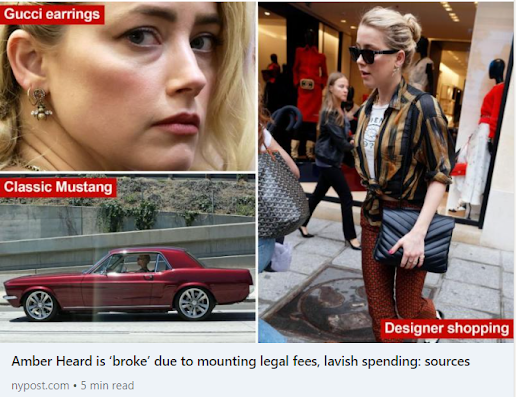
I rarely learn anything useful from the New York Post, but this article reports that Amber Heard "had to switch legal representation and is relying on her homeowner’s #insurance policy to cover the cost of her attorneys in the case. The bill for Heard’s attorney has mostly been footed by The Travelers Companies, Inc under terms of the actress’s insurance policy, sources said." "Mostly" likely because Travelers would not be responsible for paying attorneys' fees and costs associated with the prosecution of Heard's $100 million counterclaim against Depp.

Most homeowners policies don't provide coverage for "personal injury", defined to include "injury arising out of one or more of the following offenses, but only if the offense was committed during the policy period: *** 4. Oral or written publication of material that slanders or libels a person or organization or disparages a person's or organization's goods, products or services[.]" Personal umbrella policies typically provide "personal injury" coverage. I'm guessing that the Travelers policy that provided defense costs is a PULP (personal umbrella liability policy) sitting above Heard's homeowners policy.

The article is probably correct, however, in pointing out that Heard's policy with Travelers will likely NOT provide indemnification coverage for Johnny Depp's $10 million compensatory damages verdict against Heard. PULPs typically exclude personal injury coverage for:
"Personal injury":
a.  Caused by or at the direction of an "insured" with the knowledge that the act would violate the rights of another and would inflict "personal injury";
b.  Arising out of oral or written publication of material, if done by or at the direction of the "insured" with knowledge of its falsity;
c.  Arising out of oral or written publication of material whose first publication took place before the beginning of the policy period;
d.   Arising out of a criminal act committed by or at the direction of an "insureds"; or
e.  Sustained by any person as a result of an offense directly or indirectly related to the employment of this person by the "insured"[.]
The jury's positive finding on each of the prima facie elements of defamation on the three statements in Heard's op ed piece likely triggers at least one of these exclusionary provisions--"b."--and possibly two of them--"a." and "b."

I'm no bankruptcy lawyer but I do know that judgments based on intentional torts, like libel with malice aforethought, are NOT dischargeable in bankruptcy.

#personalinjury #defamation #insurancecoverageinthenews

Monday, January 21, 2019

Copy Compiled from Underwriting Records Ruled Not Best Evidence of the Policy. Judgment for Insurer Reversed and New Trial Ordered.

COMMERCIAL GENERAL LIABILITY – DESIGNATED ONGOING OPERATIONS EXCLUSION ENDORSEMENT – DUTY TO DEFEND & INDEMNIFY – BEST EVIDENCE RULE 
Pennsylvania Lumbermens Mut. Ins. Co. v. B&F Land Dev. Corp.
(2nd Dept., 1/16/2019)

Fatal accident involving a worker on defendant's property formed the basis of the estate's underlying action for personal injuries and wrongful death.

At the time of the accident, defendant B&F had a CGL policy in force with plaintiff, PLM.  PLM received notice of the death on April 15, 2009, issued a reservation of rights on May 4, 2009, and denied coverage under the policy on June 22, 2009.  PLM's coverage declination was based on: (1) the location of the loss not being a location listed on the policy; (2) the policy's exclusion for bodily injury arising out of B&F's ongoing operations; and (3) late notice.

Two months later, PLM commenced this action against B&F and the executor of the decedent's estate for a judgment declaring that PLM was not obligated to defend or indemnify B&F in the underlying action. B&F defaulted, but the executor answered.

In May 2016, PLM proceeded to a non-jury trial against the executor.  PLM called only one witness, its vice president of claims. Over the executor's objection, and after a voir dire examination, Supreme Court admitted into evidence a copy of the policy which was proffered by PLM. The copy of the policy admitted into evidence, which had been compiled by PLM's claims VP based upon information contained in the underwriting file, did not specify a location for which the policy applied. Moreover, the copy of the policy admitted into evidence provided a different description of an endorsement titled "Exclusion- Designated Ongoing Operations" than a copy of the policy that PLM had produced during discovery. When questioned about the discrepancy, PLM's claims VP did not know which version of the endorsement applied to the policy issued to B&F.  The executor did not call any witnesses and, after the parties submitted posttrial memoranda, Supreme Court issued an order granting PLM's application for a judgment declaring that it was not obligated to defend or indemnify B&F in the underlying action. The executor appealed.

In REVERSING Supreme Court's judgment in favor of PLM and ordering a new trial, the Second Department ruled that Supreme Court's admission of the policy copy over objection at at trial violated New York's "best evidence rule":
The best evidence rule requires the production of an original writing where its contents are in dispute and are sought to be proven (see Schozer v William Penn Life Ins. Co. of N.Y., 84 NY2d 639, 643; Stathis v Estate of Karas, 130 AD3d 1008, 1009; Kliamovich v Kliamovich, 85 AD3d 867, 869). Under an exception to the rule, "secondary evidence of the contents of an unproduced original may be admitted upon threshold factual findings by the trial court that the proponent of the substitute has sufficiently explained the unavailability of the primary evidence and has not procured its loss or destruction in bad faith" (Schozer v William Penn Life Ins. Co. of N.Y., 84 NY2d at 643 [citations omitted]). The proponent of the secondary evidence "has the heavy burden of establishing, preliminarily to the court's satisfaction, that it is a reliable and accurate portrayal of the original" (id. at 645).
Here, PLM failed to offer any explanation as to the unavailability of the primary evidence, i.e., the original policy. PLM also did not establish that the copy of the policy proffered at trial was a "reliable and accurate portrayal of the original" (id.). In that regard, during voir dire examination, Santoro acknowledged that he had compiled the copy of the policy proffered by PLM at trial based upon information contained in the underwriting file, and he could not explain the language discrepancy between that copy of the policy and the copy of the policy produced by PLM during discovery. Consequently, the Supreme Court should not have admitted into evidence the copy of the policy proffered by PLM at trial. The error was not harmless since, without the original policy or an accurate replication, PLM could not establish what locations were covered by the policy, what exclusions to coverage, if any, existed under the terms of the policy, or the insured's responsibilities with respect to providing notice of the claim to PLM (see Stathis v Estate of Karas, 130 AD3d at 1011).
At the retrial, if the "original" policy cannot be found and offered, someone needs to do a better job (1) explaining why the original is not available and (2) establishing that the copy is a reliable and accurate portrayal of the original.    

Monday, October 10, 2016

Can You Find The The Mistake?

HOMEOWNERS – INTENTIONAL ACT – CRIMINAL ASSAULT – DUTY TO DEFEND – DUTY TO INDEMNIFY
State Farm Fire & Cas. Co. v. Gloria
(Sup. Ct., Suffolk Co., decided 3/14/2016)

When I was blogging regularly I rarely blogged about decisions from trial-level courts.  Trial-level decisions are rarely significant enough to merit your time and my effort on these pages.  But I came across this decision today and decided to throw it on here as a sort of can-you-find-the-mistake exercise.

We all know that for liability insurers the duty to defend is broader than the duty to indemnify and is determined, in the first instance, by the allegations of the complaint.  You may also know that once that the liability insurer can establish that it will have no duty to indemnify, its duty to defend terminates.  And that collateral estoppel, when applicable, precludes the re-litigation in a subsequent action of an issue raised and decided against an insured in a prior action.

I think the court made a mistake in deciding State Farm's motion for summary judgment.  Can you find it?  Comment below if you can.