Showing posts with label Insurance Disclosure. Show all posts

Sunday, January 2, 2022

CIDA Light -- Coming Soon (We Hope)

Yesterday, New Year's Day 2022, I posted about New York Governor Kathy Hochul's unfortunate and ill-informed signing of New York's new, so-called Comprehensive Insurance Disclosure Act--CIDA for short--on New Year's Eve, December 31, 2021.  

Today I learned that a lighter version of CIDA, which derives from Senate Bill S7052, is already in the works.  In her CIDA approval memo, Gov. Hochul reportedly stated:
I agree with the intent of the bill and have reached an agreement with the Legislature to ensure that the scope of the insurance coverage information that parties must provide is properly tailored for the intended purpose, which is to insure that parties in a litigation are correctly informed about the limits of potential insurance coverage.
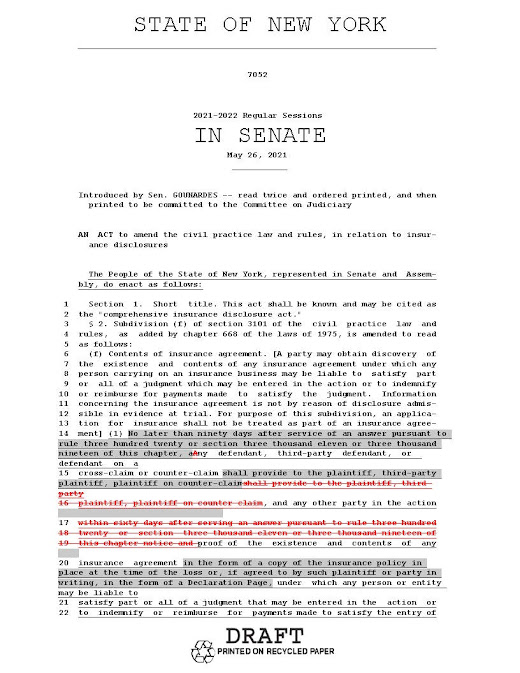
This morning I received a marked-up version of S7052, uploaded and linked below (thank you Javier R. Tapia of NYIA) that may represent the "agreement" Gov. Hochul spoke about in her approval memo and the "likely future version" of an amended CIDA (which I've dubbed CIDA Light). Bear in mind that NY's Assembly and Senate still need to pass and Gov. Hochul needs to sign an amended version before it supersedes the CIDA ("Original Strength CIDA") that is already in effect. 

But if the marked-up version below represents what eventually will become New York's new comprehensive #insurance disclosure law, the significant differences between Original Strength CIDA and CIDA Light are:
  • CPLR 3101(f)(1):  the mandated disclosure must be made within 90 days rather than 60 days of service of the disclosing party's answer; 
  • 3101(f)(1): the "proof of the existence and contents of any insurance agreement" that must be provided can be "in the form of a copy of the insurance policy in place at the time of the loss or, if agreed to by such plaintiff or party in writing, in the form of a Declaration Page";
  • 3101(f)(1): a party who agrees to accept a declarations page instead of a complete copy of the policy is entitled to the other information required by CPLR 3101(f)(1) and can revoke that agreement at any time and insist on a policy copy;
  • 3101(f)(1)(i): the "policies, contracts or agreements" that must be disclosed are only those that "relate to the claim being litigated";
  • 3101(f)(1)(iii): only the name (not telephone number) and email address of "an assigned individual responsible for adjusting the claim at issue" must be disclosed; 
  • 3101(f)(1) subparagraphs (v) and (vi) have been deleted and subparagraph (iv) is amended to require disclosure only of "the total limits available" under the relevant policy/contract/agreement, meaning "the actual funds, after taking into account erosion and any other offsets" available to satisfy a judgment; 
  • 3101(f)(2): disclosing parties will not have an "ongoing obligation" to make the required disclosures but "must" make reasonable efforts to provide accurate information initially and at the time the note of issue is filed, when engaging in court-conducted or court-supervised settlement negotiations, at mediation, and when the case is called for trial; CIDA's original 60-day post-settlement/judgment disclosure requirement remains; 
  • 3101(f)(3): policy applications are NOT to be treated as "part of an insurance agreement" (meaning they do not need to be disclosed)" and the "[d]isclosure of policy limits under this section shall not constitute and admission that an alleged injury or damage is covered by the policy"; 
  • 3101(f)(5): the new disclosure requirements "shall not apply to actions brought to recover motor vehicle insurance personal injury protection benefits under Insurance Law Article 51 or Insurance Regulation 68"; and
  • the revised CIDA is to "take effect immediately [upon the governor's signing of it] and apply to all actions commenced on or after the effective date"; the original retroactive provision ("to all pending actions") has been deleted. 
The new, double-certification requirement (new CPLR § 3122-b), however, remains.  

CIDA Light's addition of  an explicit exception for "actions brought to recover motor vehicle insurance personal injury protection benefits under Insurance Law Article 51 or Insurance Regulation 68" (i.e., PIP coverage suits) has me confused.  Does CIDA apply to first-party property coverage actions sued in NY state courts? The proposed addition of a PIP suit exception would be unnecessary if CIDA applied only to third-party liability claims. But the first sentence of Senate S7052's "Justification" section speaks of the need for complete, accurate and timely information about the nature and extent of insurance coverage "[i]n personal injury cases[.]" And the "excess and  umbrella policies" referred to in 3101(f)(1)(i) typically provide third-party liability coverages, not first-party property coverages.  Can someone explain?  Does CIDA apply to first-party property coverage suits? 😕

New York's next legislative session is slated to begin on January 5, 2022. The hope is that the amended bill will get passed and signed soon, possibly in January. After all, Original Strength CIDA, now in effect, requires that the mandated disclosures be made by March 1, 2022 (60 days after its effective date for all pending and applicable state court actions).

CIDA Light is less filling, but still doesn't taste great.


Saturday, January 1, 2022

New York. New Year. New "Comprehensive Insurance Disclosure" Bad Law.

Happy New Year, everyone. 

Unfortunately 2022 started with some bad news 👎 for insureds and their liability insurers that are or will be facing lawsuits in New York state courts.

Heretofore in New York state court practice, discovery proceeded via demands and responses.  No demand made?  No response required.  Today things are different in New York.  As of today, parties facing claims that could result in money judgments that an insurance or self-insurance policy, contract or agreement might cover and satisfy are obligated affirmatively (i.e., without a demand) to disclose certain "information and documentation" relating to such policies/contracts/agreements within 60 days of answering such claims in new suits or within 60 days from yesterday in old suits.  

Yesterday, December 31, 2021, New York Governor Kathy Hochul signed S7052/A8041, New York's Comprehensive Insurance Disclosure Act, into law effectively immediately

The act transforms CPLR 3101(f) by now requiring that "[a]ny defendant, third-party defendant, or defendant on a cross-claim or counter-claim shall provide to the plaintiff, third-party plaintiff, plaintiff on counter-claim, and any other party in the action within [60] days after serving an answer pursuant to [CPLR] rule [320] or section [3011] or [3019] of this chapter notice and proof of the existence and contents of any insurance agreement under which any person or entity may be liable to satisfy part or all of a judgment that may be entered in the action or to indemnify or reimburse for payments made to satisfy the entry of final judgment." 

Notice and proof of the existence and contents of any potentially applicable insurance agreements.  That doesn't sound so bad, right? 

Wrong. The "information and documentation" that must be disclosed under this new are (verbatim from the act): 
  • (i) all primary, excess and umbrella policies, contracts or agreements issued by private or publicly traded stock companies, mutual insurance companies, captive insurance entities, risk retention groups, reciprocal insurance exchanges, syndicates, including, but not limited to, Lloyd's Underwriters as defined in section [6116] of the insurance law, surplus line insurers and self-insurance programs sold or delivered within the state of New York;
  • (ii) a complete copy of any [such] policy, contract or agreement referred to in subparagraph (i) of this paragraph, including, but not limited to, declarations, insuring agreements, conditions, exclusions, endorsements, and similar provisions [and the application for insurance for any such insurance agreement];
  • (iii) the contact information, including telephone number and e-mail address, of any person or persons responsible for adjusting the claim made to or against the person or entity described in subparagraph (i) of this paragraph, including third-party administrators and persons within the insuring entity to whom the third-party administrator is required to report;
  • (iv) the amounts available under any [such] policy, contract or agreement to satisfy a judgment described in this subdivision or to reimburse for payments made to satisfy the judgment;
  • (v) any lawsuits that have reduced or eroded or may reduce or erode such amounts referred to in subparagraph (iv) of this paragraph, including the caption of any such lawsuit, the date the lawsuit was filed and the identity and contact information of the attorneys for all represented parties therein; and
  • (vi) the amount, if any, of any payment of attorney's fees that have eroded or reduced the face value of the policy, along with the name and address of any attorney who received such payments.
I'm guessing that subparagraph (i) requires a list of policies, contracts or agreements, whereas subparagraph (ii) requires copies of those policies, contracts or agreements.

That's the extent of the new, so-called and jurisdictionally unique comprehensive insurance disclosure  requirements in New York.  And it that weren't enough, the act imposes on the parties obligated to make these disclosures "an ongoing obligation to make reasonable efforts to ensure that the information remains accurate and complete, and provide updated information to any party to whom this information has been provided within [30] days of receiving information rendering the prior disclosure inaccurate or incomplete in whole or in part."  

Wait...but defendants and their counsel don't typically possess or control the "information and documentation" required to be disclosed; their insurers/captives/RRGs/reciprocals/syndicates typically do.  Imagine the phone calls and emails going forward.  (Liability insurers--please do me and other defense counsel a solid and tell your 3rd-party attorney bill auditing vendors to allow for those time entries.)

And for HOW LONG does this "ongoing obligation" exist?  To infinity and beyond?  Not quite, but the ongoing disclosure "obligation shall exist during the entire pendency of the litigation and for [60] days after any settlement or entry of final judgment in the case inclusive of all appeals." Did you catch that? Even BEYOND the conclusion of the case. 

What must accompany this new, comprehensive disclosure of "information and documentation", you ask?  A simple cover letter?  No, no.  Two, new, sworn or affirmed certifications, of course: 
one by by the party obligated to make the disclosure under the new (but not improved) CPLR 3101(f), 
and the second by that party's attorney, 
both certifications being required to aver "that the information is accurate and complete, and that reasonable efforts have been undertaken, and in accordance with paragraph two of subdivision (f) of section [3101] of this article will be undertaken, to ensure that this information remains accurate and complete." 

Unfortunately, the new law makes no mention of or provision for redacting PII.  As someone whose practice includes the defense of insureds in New York state court lawsuits, and until a court orders me otherwise, my attorneys and I are going to err on the side of caution (and existing privacy laws) and redact any PII that may be in the required insurance disclosure.  

WHEN does this act take effect? IMMEDIATELY (signed December 31, 2021):
This act shall take effect immediately and apply to all pending actions. Any information required by this act that has not previously been provided in pending cases shall be provided within [60] days after such effective date.
Defense counsel better get crackin'. Terrible as this new law may be, they and their clients have until March 1, 2022 (60 days after the act became effective) to comply with it and provide the required "information and documentation" disclosures and certifications to parties currently litigating third-party liability claims, cross claims or counterclaims against them in New York state courts. 

Any way you look at it, this is a horrible heffalump, herrible hoffalump, hellible horralump, hoffable hellerump piece of legislation.